International Law
Why do we need an international law article?
Columbia University invests in corporations that violate international law. It compels its workers to perform research that will be used to break the law. And it hides the extent of the damage by obscuring its finances. We can change that.
We want a workplace compliant with international human rights law. This requires Columbia to implement two important changes.
-
We want Columbia University to divest from from any private company, state actor, or financial institution complicit in violations of international human rights law, the genocide convention, or crimes against humanity.
Our framework for divestment is intentionally broad. We require divestment from companies that violate international human rights law as defined by the UN’s International Bill of Human Rights, the International Criminal Court’s Rome Statue, and the UN’s Genocide Convention.
The Office of the United Nations High Commissioner for Human Rights (OHCR) has published a guideline and two supplements to identify corporate complicity in violations of international law. See the UN’s “Guiding Principles on Business and Human Rights” and two supplements, “Human Rights Translated 2.0: A Business Reference Guide” (most useful) and “OECD Due Diligence Guidance for Responsive Business Conduct.”
Our contract article would allow student workers to file grievances against the University if it does not immediately divest from any direct or indirect holding that violates international law according to the UN or ICC.
-
We want Columbia University to practice comprehensive financial transparency to ensure our workplace environment is compliant with the norms of international law, workplace equity, and safety. Columbia must publish all its revenue streams and direct and indirect investments.
Why is this necessary? Columbia systematically obscures most of its investments and revenue streams to avoid blame for investments and other expenditures it knows are unpopular.
Columbia does not publish information about:
Indirect investments, e.g. ETFs (although the Columbia University Investment Management Company may share upon request)
Private investments, e.g. venture capital
Investments hidden by shell companies
Detailed revenue streams or expenditures
How donor gifts, grants, and contracts are invested
“Transparency is an issue.” In a 2023 analysis published on the Columbia AAUP webpage, an independent financial auditor found that Columbia is less transparent than peer institutions.
All colleges and universities are required to disclose data to the Integrated Postsecondary Education Data System (IPEDs). But the auditor found that Columbia’s data on the IPEDs website did not match its annual financial reports.
Columbia uses accounting tricks to conceal its revenue and expenses. For example, Columbiareports its “natural expenses” by combining compensation and benefits into one category to obscure how much it pays in salary, and combines “instructional and educational administration” to obscure the difference between faculty and administrative salaries. In contrast, Harvard separates their natural expenses into Salaries and Wages, Employee benefits, Purchased services, Supplies and equipment, Space and occupancy, Interest, Depreciation, Scholarships/awards, and Other.
The international law contract article solves these problems by demanding Columbia disclose all its direct and indirect financial holdings, revenue streams, and expenditures.
Learn more and get involved
Our labor is being used to violate international law. Show your support for SWC’s International Law article through our action hub and by distributing resources like flyers and our FAQ.
The Palestine Working Group drafted the International Law article in Fall 2025 after SWC’s Bargaining Positions survey showed members support an article demanding Columbia comply with International Law.
Case Studies
Case study: Columbia funds the company that manufactures the tank used to kill Hind Rajab.

Ametek, one of Columbia’s investments, manufactures parts for military equipment including fighter jets, tanks, drones, helicopters, and missiles. The Merkava tank is Israel’s primary tank. It uses Ametek parts.
Satellite imagery indicates soldiers shot Hind and her family from Merkava tanks.
Columbia ended its direct investments in publicly traded oil and gas companies in 2021. But many of our investments are “indirect,” including iShares Exchange Traded Funds (ETFs). Through iShares, our fossil fuel investments include Chevron, ExxonMobil, and Saudi Oil.
These companies have been complicit in major international law violations including torture (ExxonMobil), dumping wastewater in the Amazon (Chevron), and accelerating the production of fossil fuels in violation of the Paris Agreement (Aramco). Aramco is a state-owned company operated by and directly benefiting the Kingdom of Saudi Arabia, which has a long list of human rights abuses including the the 2018 murder of journalist Jamal Khashoggi.

Case study: Columbia profits from torture, murder, and global pollution via fossil fuels.

Case study: Columbia workers are compelled to develop drones to target pedestrians (in partnership with Boeing).

DoD grant award: “Novel Large, Flexible Light Emitting Arrays.” This research, in partnership with Boeing, won nearly $1M to reduce the visibility of unmanned aerial vehicles (drones). The application states expressly that the “camouflage approach” they developed is useful for “urban missions, where foot soldiers can shoot [drones] down with unsophisticated weapons.” This grant was active from 2007-2009 and was likely used for Obama-era drone warfare to get within shooting range of cities to target pedestrians who were either unarmed or had seriously asymmetric capabilities.
Case study: Columbia workers are compelled to biohack organisms for military technology that is in the early stages of real mind control.
DoD grant award: “Reengineering the Nervous System of a Cnidarian.” This $3M grant is an example of well-intentioned research likely to be used to commit war crimes. The grant proposes to "break the code" of a Hydra in order to “design novel behaviors.” If successful, it will be “the first systematic neural code-breaking to date and could revolutionize…[nervous] control systems.”
The grant’s PI has co-founded an organization called the Neurorights Foundation, which promises to “safeguard” neurotechnologies from “from misuse or abuse.” But their research on what is essentially mind control is still funded by the DoD. Shouldn’t our colleagues have the option to switch labs if they decide they’re uncomfortable doing mind control research for the Department of War?
Take Action
Just for members
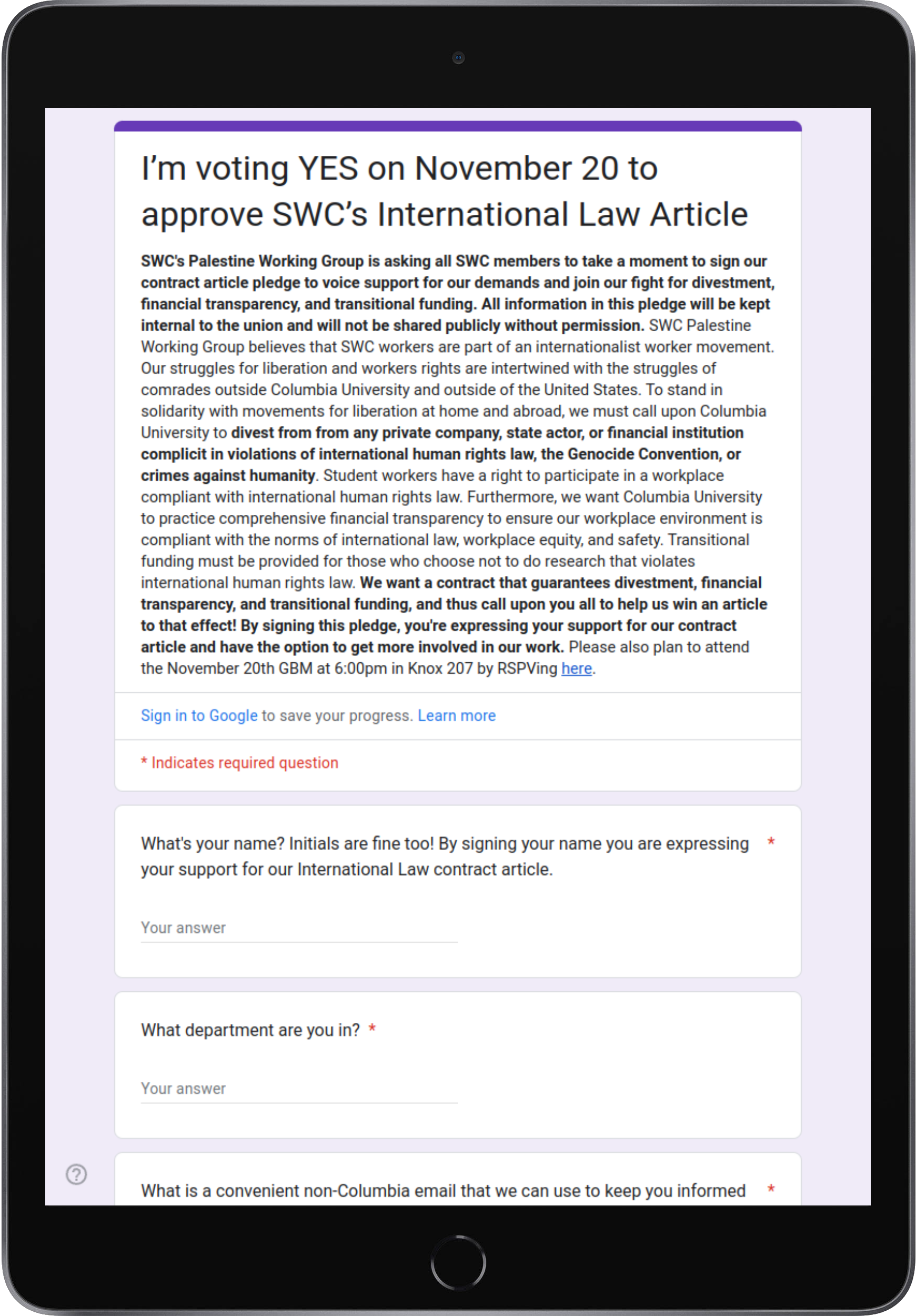
On November 20, 2025, Student Workers of Columbia voted 109-5 (with two abstentions) to pass the International Law article. RSVP to our next bargaining session or attend an upcoming Workplace Council meeting to join the campaign for a just workplace. You can find meeting details on our calendar.
Organizing resources for all

-
The International Law Article FAQ is a living document that answers questions like:
How do we define “international human rights law”?
Which direct and indirect holdings does the article require Columbia to divest from?
If the article doesn’t name specific corporations or nation states for divestment, how will we decide where to divest?
Is the University really required to bargain with us over this?
-
SWC’s Palestine Working Group maintains a Google Drive folder of downloadable flyers to promote the International Law contract article and support for Palestinian liberation. Download flyers here.
Are you an organizer from another institution who wants to adapt our flyers for your union? Email info@studentworkersofcolumbia.com for a Canva template.
-
Here are third-party resources we’ve found helpful:
CU Researchers Against War (RAW) teach-in materials (highly recommended for basic self-education)
Columbia’s investment portfolio according to ACSRI
Can we really win divestment?
It’s true that divestment faces a steep road ahead. But other institutions for higher education and research have already won divestment. We can be next.
No organizing victory takes place in a vacuum. Here are recent divestment wins that inspired our work.
Microsoft
On September 25, 2025, Brad Smith, Microsoft President, notified employees that “Microsoft has ceased and disabled a set of services to a unit within the Israel Ministry of Defense (IMOD)” that were used for surveillance to enforce Israeli apartheid following a years-long campaign by “No Azure for Apartheid” (NOAA).
The campaign followed a familiar beat, including an open letter, a sit-in, event disruptions, and an encampment.
Up until the end, the campaign was met with bitter resistance by Microsoft, including by firing an employee for exercising their right to protest.
This marks the first divestment win in a “Magnificent 7” stock.
MIT
In April, 2025, the MIT Industrial Liaison program ceased working with Elbit Systems, a weapons manufacturer that provides up to 85% of the IDF’s land-based equipment and drones.
The announcement was made after the Massachusetts Institute of Technology Graduate Student Union passed a resolution on April 19 calling for MIT to cut all research and financial ties with the Israeli military.
Trinity College Dublin
On June 5, 2025, Trinity College Dublin publicly announced that it had cut all financial and institutional links with the State of Israel, Israeli universities and companies headquartered in Israel. Their commitment includes divestment from Israeli companies on the UN Blacklist (and more).
Trinity College Dublin is the first university in the West to fully divest from Israel.
U of San Francisco
On May 5, 2025, University of San Francisco announced that by June 1, it would divest from four U.S. companies with Israeli military contracts: Palantir, L3Harris, GE Aerospace and RTX Corporation.
UTS @ CU
On May 9, 2024, the Trustees of Union Theological Seminary – an affiliate of Columbia University – announced that UTS’s Investment Committee would divest from all companies and funds “that support and profit from the present killing of innocent civilians in Palestine.”
UTS directed its investment consultants and managers to assemble a list of companies in their portfolio “substantially and intractably benefiting from the war in Palestine.” To ensure that UTS did not retain indirect investments in genocide, the trustees also wrote, “If relevant holdings are held in commingled accounts or mutual funds, we are directing the manager of those funds to divest, or we will find another alternative vehicle.”
How far we get depends on how long we want to hold out for divestment.
SWC’s bylaws require us to repeatedly reaffirm our commitment to each contract article during bargaining. Important checkpoints include strike authorization votes, caucusing (during which any article can be modified or dropped), and – if we strike – weekly votes to continue withholding our labor in support of our next contract.
Passing the International Law contract article does not require you to strike for divestment. But we hope you will hold the line by striking if necessary. It’s up to you.
Still not sure if we can win? For security reasons, we don’t share all our plans online. Ask to be put in touch with a member of the Palestine Working Group by emailing info@studentworkersofcolumbia.com.
Retaliation Support
As of Fall 2025, Columbia has not successfully penalized a single student worker for introducing material about Israel’s genocide in Gaza to their syllabus or lesson plan – in large part thanks to the successful organizing of Student Workers of Columbia.
Unfortunately, Columbia continues to violate our academic freedoms and campus speech rights in other ways. The Palestine Working group is assembling a resource hub for student workers, faculty and staff to request materials, organizing support, and support in the face of retaliation or discipline for your organizing. You do not need to be a student worker or member of SWC to request our support.
The International Law article, which was written by SWC’s Palestine Working Group, does not directly address academic freedoms. SWC promotes free speech through a separate academic freedom article. However, it is our position that securing a commitment to divest from companies that violate international law would make it difficult for Columbia to retaliate against members of our community who stand up for the same principles advocated by the United Nations and Interntional Criminal Court.

Scan the QR code or visit
tinyurl.com/swc-retaliation-support
UAW also maintains an immigration hotline for members. In the event that a member is experiencing an unexpected change in immigration status or any other immigration-related issue, call this number to be connected with legal counsel: 888-416-2110.
If you fear a change to your visa or SEVIS status, we recommend contacting the UAW immigration hotline as well as reaching out directly to an SWC organizer through the Google form or via WhatsApp/Signal.
This webpage is maintained by SWC’s Palestine Working Group